
Here is a question most families never think to ask: if your child met the clinical criteria for a treatable medical condition, would you expect their doctor to tell you? Of course you would. Yet when the condition is obesity, the data now shows that for most young people, that conversation never happens.
What the Newest Data Shows
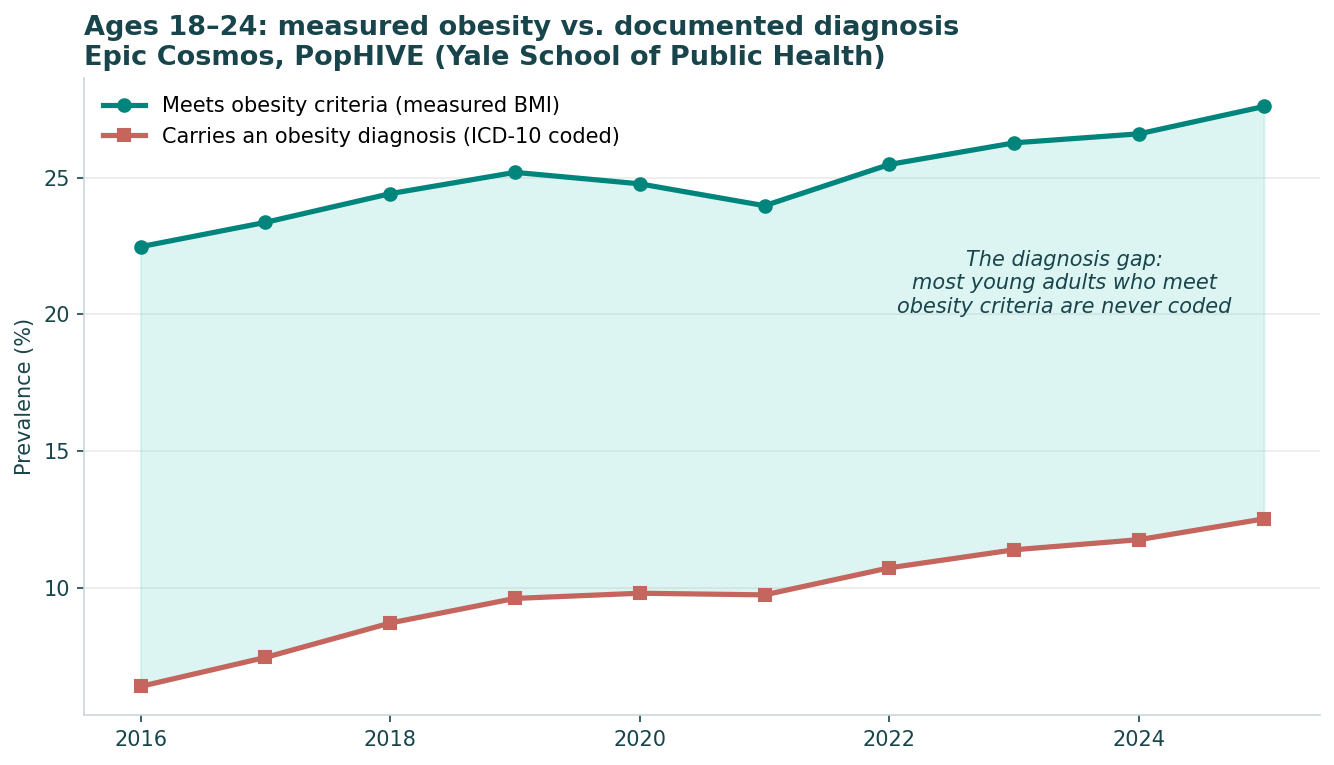
In 2025, researchers analyzing millions of electronic health records through PopHIVE, a public health data platform led by the Yale School of Public Health, could see two things side by side for the same population: how many young adults measured in the range that meets clinical obesity criteria, and how many actually had an obesity diagnosis documented in their chart [1] [2].
The two numbers should be close. They are not.
27.6%
of 18 to 24 year olds met clinical obesity criteria in 2025, based on measured BMI from more than 9 million health records. Yet only 12.5% carried a documented obesity diagnosis — fewer than half of those who met criteria [2].
This is not a rounding error or a quirk of one clinic. Across all ages in the same dataset, 36.2% of patients met obesity criteria by measured BMI while only 21.9% had a coded diagnosis [2]. The pattern is consistent: a large share of people whose measurements meet clinical criteria never have that finding translated into a diagnosis, a conversation, or a plan.
Why the Gap Exists
It would be easy to read this as a story about negligent doctors. It isn't. The gap has structural causes that are worth understanding, because they explain why waiting for the system to bring it up often means waiting indefinitely.
Visit time is the first constraint. A typical appointment is built around the reason for the visit — a sore throat, a sports physical, a vaccine — and weight rarely makes the agenda unless someone puts it there. Training is the second: obesity medicine is a young specialty, and many clinicians received little formal education in treating weight as a chronic condition rather than advising generic lifestyle changes. Comfort is the third, and perhaps the most human. Many clinicians hesitate to raise weight because they worry about causing shame, especially with adolescents and young adults. And historically there was a fourth reason: until recently, there was not much a primary care visit could offer beyond "eat better and move more," which made documenting a diagnosis feel less consequential [3].
That last reason is the one that has changed most. Since 2023, the American Academy of Pediatrics has recommended proactive, comprehensive treatment for adolescents with obesity — including FDA-approved medications such as Wegovy (semaglutide) and Saxenda (liraglutide) for ages 12 and older when clinically appropriate [3] [4]. Effective treatment now exists. The diagnosis gap means most young people are never connected to it.
Key Takeaway
Why This Matters for the 12–26 Window
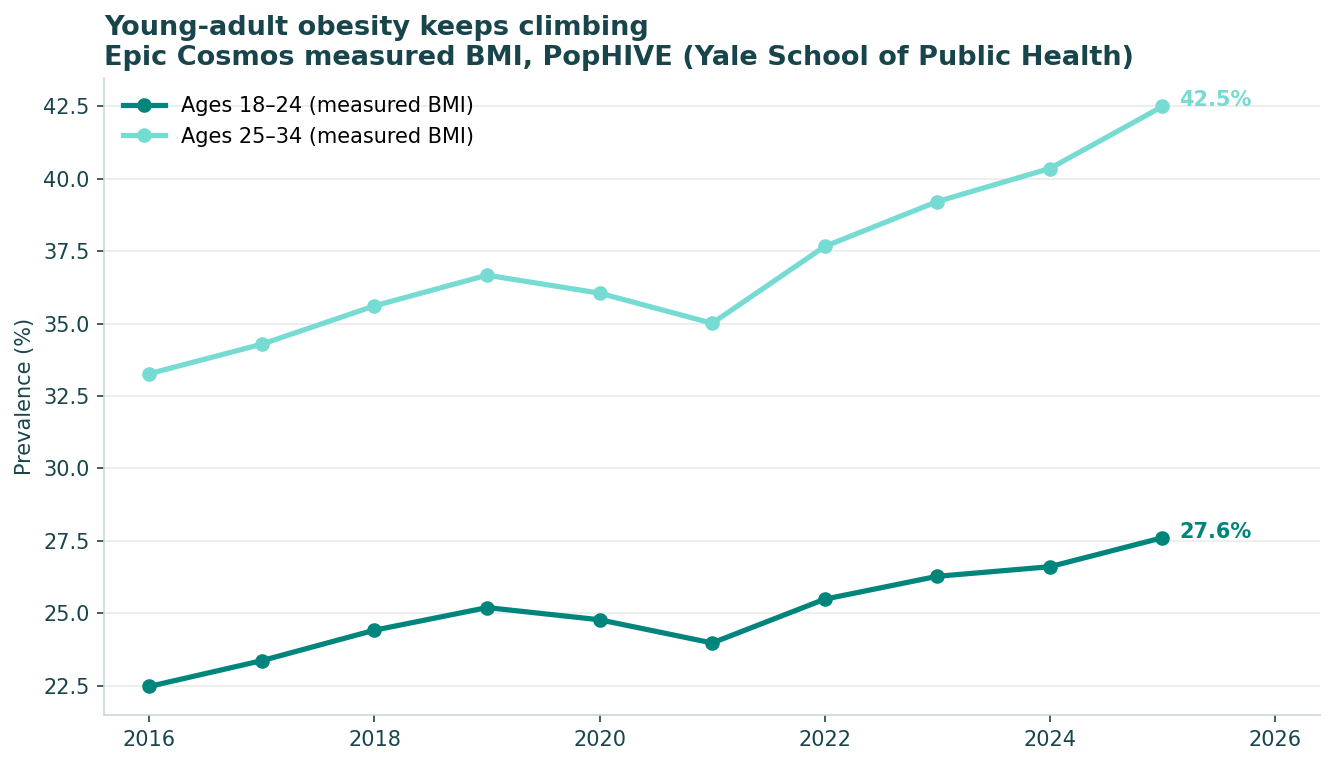
The same dataset shows why these years matter so much. Among 18 to 24 year olds, measured obesity prevalence has climbed steadily from 22.5% in 2016 to 27.6% in 2025. In the next age band up, 25 to 34, it reaches 42.5% [2]. The years between adolescence and the early thirties are when prevalence accelerates most sharply — which means they are also the window where support can change the trajectory.
There is a second signal in the data worth naming: diabetes measured by blood testing among 18 to 24 year olds rose roughly 28% over the same period [2]. Weight health and metabolic health travel together, which is why clinical guidelines treat early evaluation not as cosmetic, but as prevention.
What This Means If You're a Parent
The practical takeaway is simple but important: silence from the system is not reassurance. If your child's clinician has never raised weight, that does not necessarily mean everything has been evaluated and found fine. Statistically, it more often means the conversation simply hasn't happened.

None of this calls for alarm — it calls for one proactive step. At your child's next visit, you can ask three questions that take under a minute: What is my child's BMI percentile, and how has it trended? Are there any metabolic labs worth checking? And if weight is a concern, what are our options beyond general advice? Clinicians overwhelmingly respond well when a parent opens the door; the hesitancy documented in the research is about starting the conversation, not having it [3]. Our guide on talking with your child about weight covers how to handle the family side of that conversation with care.
You can also get the first of those three answers before the appointment. Our free calculator reads height and weight against the CDC growth charts for the same age and sex, so you walk in knowing the number rather than asking for it. Nothing is sent to us or saved.
Check a BMI percentile now →And if your child is between 18 and 26 — the group where the gap is documented most clearly — they are likely managing healthcare on their own for the first time, often through a campus clinic or urgent care visits where weight never comes up. A gentle nudge from a parent, framed around health and energy rather than appearance, can be the reason an evaluation finally happens.
Wondering if your teen qualifies?
Check Your Child's Eligibility →Closing the Gap for Your Own Family
The healthcare system will close the diagnosis gap slowly, one guideline and one training program at a time. Your family doesn't have to wait for it. An evaluation is not a commitment to medication or to any particular treatment — it is simply the step the data says most young people never get: a clinician actually looking at the whole picture, including growth history, labs, family history, and how your child feels day to day.

Thryvwell's 2-minute eligibility check is built to be that first step for ages 12 to 26. It asks the screening questions a thorough clinician would ask, tells you honestly whether a medical evaluation makes sense, and connects qualifying families with board-certified physicians who treat weight as the medical condition the evidence shows it to be — referred by pediatricians, and coordinated with them.
Key Takeaway
Frequently Asked Questions
What is the obesity diagnosis gap?
It is the difference between how many people measure in the range that meets clinical obesity criteria and how many have that finding documented as a diagnosis. In 2025, 27.6% of 18 to 24 year olds met criteria by measured BMI while only 12.5% carried a documented diagnosis [2].
Does a missing diagnosis mean my child is fine?
Not necessarily. The data shows most young people who meet clinical criteria are never diagnosed, so the absence of a diagnosis often reflects a conversation that hasn't happened rather than an evaluation that came back reassuring.
Is this data reliable?
The figures come from measured BMI values in millions of electronic health records, analyzed through PopHIVE, a public health data platform led by the Yale School of Public Health [1]. Measured clinical data avoids the undercounting seen in self-reported surveys, though it represents patients who appear in health records rather than a random population sample.
What should I actually do with this information?
Ask at the next appointment: BMI percentile and its trend, whether metabolic labs are worth checking, and what the options are if weight is a concern. Or start with a structured eligibility check to understand whether a full medical evaluation makes sense for your family.
References
- PopHIVE (Population Health Information and Visualization Exchange). Chronic Diseases Dashboard. Yale School of Public Health. Accessed July 2026.
- PopHIVE. Chronic disease prevalence by geography, year, and source (Epic Cosmos measured BMI and ICD-10 coded diagnoses). Yale School of Public Health, 2025 data release.
- Hampl SE, et al. Clinical Practice Guideline for the Evaluation and Treatment of Children and Adolescents With Obesity. Pediatrics. 2023;151(2):e2022060640.
- U.S. Food and Drug Administration. Wegovy (semaglutide) Approval Letter for Chronic Weight Management in Pediatric Patients Aged 12 Years and Older. December 2022.